
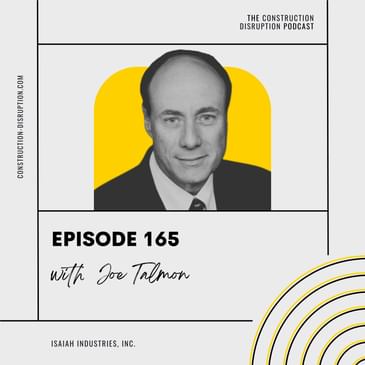
Join Todd Miller of Isaiah Industries and co-host Seth Heckman as they delve into the world of construction and home improvement with industry legend Joe Talmon. Discover Joe's journey from B2B sales to becoming a pivotal figure in the home improvement sector. Learn about his strategies for building high-performing sales teams, the importance of marketing efficiency, and the keys to sustaining organizational growth. Joe also shares his insights on leadership, team training, and creating a successful and people-focused business culture. This episode is packed with valuable lessons and inspiring stories that will benefit anyone in the home improvement and construction industries.
Timestamps
00:00 Introduction and Welcome
01:14 A Legendary Guest: Joe Talmon
02:22 Joe's Journey into Home Improvement
06:33 Building a High-Performance Sales Team
10:53 Overcoming Challenges in the 80s
20:19 Turning Around Window Works
31:48 The Valley of Death: Recognizing and Avoiding Complacency
33:17 The Importance of Continuous Training
34:06 Challenges in the Home Improvement Industry
34:29 Effective Sales Training and Management
37:06 Marketing Efficiency and Data Analysis
39:47 Defining and Achieving Business Goals
45:56 Networking and Learning from Others
48:56 Rapid Fire Questions with Joe
55:38 Final Thoughts and Contact Information
Guest Bio
Joe Talmon has a 40-year background in all areas of the home improvement industry. His earliest training started with Rainbow vacuum cleaners where he first learned the value of a high-powered sales presentation. He co-founded an Ohio company that was regarded as the largest hi-end vinyl replacement window company in Ohio for many years and was eventually sold to an investment group.
He subsequently joined Dave Yoho Associates as a Senior Consultant and is recognized for his systematic approach to improving sales performace and making businesses more profitable, Joe has a relatable speaking style that combines humor and scientifically proven training and has been a featured speaker across the country.
Joe has developed sales, marketing, and training programs for large and mid-sized industry companies from coast to coast and brings a rarely seen passion for business. He was most recently the COO and managing partner of WindowWorks in Chicago a company he took over and rebuilt to a powerhouse local brand with sales of nearly $60 million annually and it was sold to a major private equity group.
Connect with Joe Online
LinkedIn: https://www.linkedin.com/in/joetalmon/
Email: jtalmon@me.com
For more Construction Disruption, listen on Apple Podcasts or YouTube
Connect with us on Facebook, Instagram, or LinkedIn
This episode was produced by Isaiah Industries, Inc.
Construction Disruption was recently featured in this 15 Best Podcasts for Contractors list!
This podcast uses the following third-party services for analysis:
Podtrac - https://analytics.podtrac.com/privacy-policy-gdrp
I'm Todd Miller of Isaiah Industries, manufacturer of Specialty Metal Roofing.
Speaker:Welcome to Construction Disruption, the show that explores what's
Speaker:new next, and working in the construction and remodeling worlds.
Speaker:Today I'm joined by my co-host, our illustrious VP of sales, Seth Heckman.
Speaker:Seth, what's the news?
Speaker:Not a whole lot.
Speaker:It's been a good week.
Speaker:Looking forward to our conversation this afternoon.
Speaker:It's gonna be a good one.
Speaker:I agree.
Speaker:Well, I did hear some news the other day.
Speaker:Um, so the zoo, they recently were interviewing all the animals, um,
Speaker:for a particular job that they were trying to come up with at the zoo.
Speaker:They wanted a new spokesperson for the zoos, so they, they
Speaker:interviewed all the animals.
Speaker:Um, care to guess which animal.
Speaker:Got it.
Speaker:I have no
Speaker:Well, I will tell you this.
Speaker:It was the ko.
Speaker:Would you like to guess why The Koala got it?
Speaker:I still have no idea.
Speaker:Okay.
Speaker:It's because he was so qualified.
Speaker:Okay.
Speaker:Maybe we should just start the show.
Speaker:Just, just, uh.
Speaker:Yeah, let's get on
Speaker:the bandaid off.
Speaker:Let's go.
Speaker:Okay.
Speaker:Well, um, again, Seth, great to have you on, uh, here as co-host today.
Speaker:Good to see you.
Speaker:So our guest today here on Construction Disruption is a well-respected,
Speaker:uh, well-recognized legend in the home improvement industry.
Speaker:Mr. Joe Talmon has years of experience running his own operation Alarm Co
Speaker:windows based in Columbus, Ohio.
Speaker:And then later working as Chief operating office for Window Works in Chicago.
Speaker:Joe has also been a consultant and an industry speaker.
Speaker:Um, he's been associated with Dave Yoho Associates over the years known
Speaker:for his creative marketing as well as his incredibly strong leadership
Speaker:and unforgettable leadership style.
Speaker:Uh, Joe truly has been recognized as a home improvement industry legend.
Speaker:He's a wealth of knowledge and ideas.
Speaker:So, Joe, welcome to Construction Disruption.
Speaker:What a pleasure it is to have you with us today.
Speaker:Thank you for inviting me.
Speaker:It is truly a pleasure to be with you.
Speaker:Well, you know, we've been known each other for a lot of years
Speaker:and I've always had tremendous respect for you, um, and for the
Speaker:organizations that you've worked with.
Speaker:I don't wanna spend a lot of time looking at, uh, what's rapidly becoming
Speaker:ancient history for both of us.
Speaker:But, um, tell us a little bit about how you found yourself in
Speaker:the home improvement industry.
Speaker:Well, I came to the industry probably a little.
Speaker:Unique compared to a lot of folks.
Speaker:I was working, uh, with a, uh, fortune 500 company in business to
Speaker:business or B2B sales and, uh, so in the, uh, early to mid eighties.
Speaker:So what was happening was, uh, those companies at that time liked to plan
Speaker:where they paid the guys a salary or the ladies, and then you got a small bonus.
Speaker:And so the deal for me was I had about a $42,000 base company car.
Speaker:Pretty decent deal, and then maybe a three or $4,000 bonus at the end of the year.
Speaker:Now, the sad part was the bonus wasn't based on performance.
Speaker:The bonus plan was based on the company's the corporation's
Speaker:profitability, and they had this elaborate formula, and the formula
Speaker:included your base and presto whammo.
Speaker:You could have been number three, like I was one time.
Speaker:You know, 500 salespeople or you'd be number 500 and you got the same bonus.
Speaker:But anyway, after about three years, that wasn't really making me feel great.
Speaker:'cause I was trying, I was thinking I was gonna go somewhere,
Speaker:I was gonna do something.
Speaker:So I'm really gung-ho and it just really didn't matter to anybody.
Speaker:Anyway, I run into a guy who's selling windows.
Speaker:We become friends.
Speaker:We start hanging out on Friday nights in our single days.
Speaker:And at.
Speaker:Some of the places where in those days the pretty girls used to hang out.
Speaker:Believe it or not, we were there and, but we would talk a lot and he was telling
Speaker:me he was making a hundred thousand dollars selling vinyl windows and Wow.
Speaker:I just was blown away.
Speaker:I was thinking, the one thing I figured out was I wasn't gonna get rich making
Speaker:what I was making because I could save a little, but then, you know, after
Speaker:tax paid the bills, but at a hundred KI said if I made a hundred k. I
Speaker:could save and invest a lot of money.
Speaker:This could be a game changer.
Speaker:So long story short, I asked him one day, uh, if he could get me
Speaker:an interview with this company.
Speaker:And, uh, he said, well, before you do that, why don't you
Speaker:go on an appointment with me?
Speaker:So you kind of see what it's all about.
Speaker:And so I did a, a Friday afternoon ride along with him, and we went to a
Speaker:house for about two and a half hours, give or take maybe a little more.
Speaker:But he sold like just under 10 grand a, a house full of windows, these folks.
Speaker:And they loved him and they loved the thing.
Speaker:And then, so we left there and went to a little, uh, local diner, had a coffee.
Speaker:So my first question was, how much did you make on that deal?
Speaker:And he said, well, I made right about a thousand dollars.
Speaker:I said, A thousand dollars.
Speaker:Are you kidding me?
Speaker:I said, I don't make a thousand dollars in 40 hours.
Speaker:We weren't there three hours.
Speaker:So then I had this kind of joking question, but it was serious.
Speaker:I said, here's what I need to know.
Speaker:How many times a week are you allowed to do that?
Speaker:And he said, as many as you can, man.
Speaker:He says, now you want an interview?
Speaker:I said, get me in there.
Speaker:So anyway, I got involved with this company.
Speaker:Got into the industry and was having a phenomenal experience
Speaker:selling, uh, really, uh, took to it.
Speaker:I was also, uh, real serious about success.
Speaker:So I had immediately bought a bunch of, uh, cassettes, uh, you
Speaker:know, from the eighties there.
Speaker:It was all cassettes and, uh, of every major trainer,
Speaker:speaker in the world of selling.
Speaker:Of course, I love Zig Ziglar and Tom, just all of them.
Speaker:And Dave Yoho, of course.
Speaker:But the thing was, I, I lived with those cassettes and I
Speaker:got pretty good at selling.
Speaker:In fact, I started the third week of January on a real
Speaker:snowy Columbus, Ohio Friday.
Speaker:Uh, anyway, uh, made my first sale, made a thousand dollars talked.
Speaker:That's the craziest thing in the world.
Speaker:Saturday I had two leads, so one of those made another thousand.
Speaker:So in actuality, from Friday night till Saturday afternoon.
Speaker:I made $2,000 in less than 24 hours.
Speaker:I just fell in love.
Speaker:I do mean to tell you in love with this industry, and it's coming up
Speaker:on 40 years, so it's been good to me and I've tried to be good to it.
Speaker:Well, that's an amazing story and you'll no surprise that having cut your teeth
Speaker:in sales, um, that over the years you've kind of been known as a person who could,
Speaker:uh, work with a sales team, develop a very high performance sales team, do it
Speaker:in a way where you had minimal turnover.
Speaker:Tell us a little bit about how you accomplished that with
Speaker:the sales teams you've led.
Speaker:Yeah, I think that's a great question, uh, because I talked to
Speaker:so many people and have over the last, uh, three decades or so about
Speaker:their problems with sales turnover.
Speaker:So my philosophy was pretty simple.
Speaker:Uh, and when we first got going, I thought, you know, a great metric for
Speaker:a business to measure your success.
Speaker:Something unusual might be how big is the payroll to the salespeople?
Speaker:So the idea was if the payroll to sales was really, really big, we
Speaker:were probably making it happen.
Speaker:And if it was kind of skinny, we probably had troubles.
Speaker:So that was a so to now to how to make that thing work.
Speaker:I said, let's build a business that really, really focuses
Speaker:on taking care of sales fee.
Speaker:And, uh, that was important to me.
Speaker:'cause a couple meetings I went to in the early years, they
Speaker:were really shockers to me.
Speaker:Keep in mind I'd come out of a Fortune 500 really stuffy kind of place.
Speaker:And so in this meetings they were talking about these low life no good salespeople.
Speaker:And I was like, what?
Speaker:And you know, these cheating line no goods and all this stuff.
Speaker:And they used some colorful language.
Speaker:Some of the guys, you know, there's about 20 of 'em I end up in this meeting with.
Speaker:And, uh, you know, that was really weird.
Speaker:And like the, like some of 'em would say things like, and you gotta, you
Speaker:know, do certain things before they do it to you and you gotta, you know,
Speaker:it's like, what a weird way, you know, I never was exposed to such things.
Speaker:So anyway.
Speaker:I said, I don't wanna be anything.
Speaker:I do not wanna be anything like that.
Speaker:I wanna build a culture.
Speaker:I didn't even use the word culture, but that's what I meant back then.
Speaker:Uh, you know, it's big now.
Speaker:The word culture in the eighties, culture was, no one knew
Speaker:what you were talking about.
Speaker:But anyway, uh, where people could come to work, uh, sell ethically.
Speaker:With preeminence where you really did what was best for the customer at all times.
Speaker:You know, if the customer had 10 really crappy windows, putting three
Speaker:in, ain't gonna do anything for 'em.
Speaker:You know, the principal preeminence would say, well, if they need
Speaker:10, you need to help them get 10.
Speaker:On the other hand, you don't take some 97-year-old grandmother and put her in
Speaker:a $15,000 loan for 180 months either.
Speaker:So we sold and we built an organization based on integrity,
Speaker:and the idea was it was integrity for the salespeople, integrity for
Speaker:the client to customer at all times.
Speaker:And then mutual respect.
Speaker:We respect the brand, we protect the brand, but we
Speaker:respect and protect each other.
Speaker:And I, you know, my philosophy was I believed that if we really did
Speaker:that we could do something exciting.
Speaker:And by constantly staying right there, not wandering out too far with all these crazy
Speaker:ideas that were always floating around our business, uh, it worked really well.
Speaker:Worked really well.
Speaker:We had very minimal turnover.
Speaker:I remember one time and somebody told me I was wrong for this, but
Speaker:one time, one of our offices, uh, in, in the Columbus, you know, we had
Speaker:Cleveland, a few others at one point, but um, I think we had 12 salespeople.
Speaker:And I, if I remember correctly, our newest rep had been there five years.
Speaker:Our oldest rep had been there 13 years.
Speaker:Everybody's making like 125 to 150 grand, which was a lot of money back then.
Speaker:And a couple people, maybe one or two closer to 1 75.
Speaker:And loving what we were doing, loving how we did it.
Speaker:And also, I gotta say something about production because, uh, you know, back
Speaker:then I met a lot of people that were, their focus was make the sale, get
Speaker:the money, slam it in and forget 'em.
Speaker:And I mean, sad to say, you know, get the money and forget 'em.
Speaker:And, you know, we really worked hard in the early days of getting as much training
Speaker:for installers and they had to have the same integrity philosophy that we had.
Speaker:And we did beautiful work and we cared for people.
Speaker:And so the salesman really appreciated that.
Speaker:They didn't wanna leave for one of these companies, has got 200
Speaker:complaints at the B, B, b, you know, they, they just like the whole vibe.
Speaker:And so when they're comfortable with the holistic.
Speaker:Aspects of the business, not just their paycheck.
Speaker:It's hard to get rid of 'em.
Speaker:It's hard to see 'em go.
Speaker:Well, I think that's some fantastic insight and I, I'm right there with you.
Speaker:I mean, so often you hear people talk badly about their sales
Speaker:groups and their sales teams.
Speaker:I'm like.
Speaker:These are the guys that are your lifeblood.
Speaker:This is, uh, you know, who's making it all happen for you.
Speaker:So it just doesn't make sense to me.
Speaker:But, you know, I think it's interesting.
Speaker:So you started Alarm Co Windows as a startup in the eighties,
Speaker:that wasn't necessarily the most friendly time to start a business.
Speaker:Interest rates were high, inflation was high, people didn't wanna buy.
Speaker:I mean, you had a lot of challenges, um, but yet you still.
Speaker:Here in this Ohio market, um, you had tremendous growth and success.
Speaker:Can you tell us a little bit about some things that, um, you did that allowed
Speaker:you to grow that operation so quickly?
Speaker:Well, first of all, you have to have the right people, and I was very,
Speaker:very focused on quality people.
Speaker:I believe, uh, that you know, when you have quality people, you can teach them
Speaker:skills, but when you have poor quality or low level people that, uh, lack integrity,
Speaker:they're just in it for a quick buck.
Speaker:Uh, you know, then you, you can really struggle.
Speaker:So we start with PE people of integrity and quality people.
Speaker:That doesn't mean perfect people.
Speaker:There are no perfect people, but good people.
Speaker:Then we work on developing skills, high skills.
Speaker:I've always said the numbers will accelerate in proportion to
Speaker:the skills of your salespeople.
Speaker:Your installers and your staff.
Speaker:So we were always working on building skills.
Speaker:So suddenly our salespeople would out our 12, say in Columbus or 12 in Cleveland
Speaker:at that time, uh, that we eventually got those two places running, could outsell
Speaker:sales groups with 25 to 30 salespeople.
Speaker:People we're talking about 20% close, 25% close, 30%.
Speaker:We were closing 42, 44, 40 6% because the client to customer loved
Speaker:the way we did business with them.
Speaker:Now, we did ask them to buy, we didn't say, okay, here's your quote, you
Speaker:know, you give us a call on telephone 'cause that's how it was done.
Speaker:You know, just old fashioned wired up telephones.
Speaker:But no, we would, we would always think, you know, if you love what we have.
Speaker:And you really feel good about what we could do for you, and
Speaker:then if quite frankly, we could make it fit in the budget without
Speaker:taking any food off the table.
Speaker:Could you think of one good reason why we shouldn't just get
Speaker:your project ordered right now?
Speaker:Most people would say, Hmm, well, I guess not.
Speaker:Well, anyway.
Speaker:So what?
Speaker:By having a very efficient sales team, lots of integrity
Speaker:through the organization.
Speaker:Then the next big piece is marketing.
Speaker:And this is what's caused so many people I've, I've just seen hundreds
Speaker:and hundreds of people shut down over the years I've been in this business.
Speaker:Marketing efficiency is so important and today it's incredibly
Speaker:important 'cause of the cost.
Speaker:But here's the key.
Speaker:Most people when they get in a business, they don't know enough about
Speaker:the business, and one of the things they do in marketing or advertising
Speaker:is copy what other people are doing.
Speaker:Whether it's TV ads or print ads, or today internet ads, or you know, whatever.
Speaker:And the presumption is if they're doing it, it's probably working well.
Speaker:They'll find out pretty fast, and they usually do.
Speaker:They weren't working for them, but they didn't know what else
Speaker:to do, so they kept doing it.
Speaker:Then other people started doing other people that, here's the terrible part,
Speaker:back then three or four people would be running the same kind of ad in the
Speaker:paper and all these different things.
Speaker:Then the next guy says, well, if it's working for four of
Speaker:'em, it must really be good.
Speaker:He gets in, uh, four months later he finds out it didn't work for none of
Speaker:'em 'cause it isn't working for him.
Speaker:But money gets lost.
Speaker:You get no acceleration of growth and activity.
Speaker:So understanding the market dynamics, uh, the demographics, how you market, where
Speaker:you market, and then the efficiency.
Speaker:So for example.
Speaker:If we dropped, uh, over a campaign, a million pieces of direct mail,
Speaker:which was something we would do from time to time, uh, back then was
Speaker:a big deal, you know, inserts and in the mailbox and marriage mails.
Speaker:But here's the thing, we would study those zip codes and we would study
Speaker:even on some people that had like carrier routes or they'd have little
Speaker:territorial maps, you know, numbered up for you to go in this little region
Speaker:or this little region and staying on top of, was there an area, for example.
Speaker:Which there was, what are the areas where we have massive credit decline?
Speaker:Where do we have 50, 60% credit decline?
Speaker:70% one time?
Speaker:Well, yeah, we made a lot of sales there, but was very
Speaker:inefficient because the entire organization had to do so much work.
Speaker:We only netted out so little, and the people that worked on the
Speaker:phone in customer service had to do so much work to get so little.
Speaker:So we finally were able to say, you know, uh, it's just not worth stressing out the
Speaker:whole organization to go work over here, for example, for that little bit of net.
Speaker:But then the other side is knowing where your sweet spots are and
Speaker:where you have great success and saying, Hey, that's momentum.
Speaker:And the only thing, when you identify momentum you want to do,
Speaker:you ask an important question, can we push that momentum?
Speaker:Can we push it more?
Speaker:You know, they say momentum is a manager or a leader's best friend in
Speaker:business momentum, and that you never do anything to knowingly break momentum.
Speaker:You should always be looking for ways, uh, to mo a po in a
Speaker:positive way, push that momentum.
Speaker:So by doing some of those things and kind of, you know, without the computerization
Speaker:and without the sophistication, and even when we got our, you know, first
Speaker:computers in the mid nineties and our, or 93 or so, somewhere around there.
Speaker:Um, I feel like we were a little bit ahead of the general curve of the industry in
Speaker:doing analysis and so, you know, another thing where that, that helps growth is
Speaker:the way you grow needs to be strategic.
Speaker:Like, I know people that just said, uh, I'm gonna go, uh, to a town 90 miles
Speaker:away and we're gonna just market it.
Speaker:We're gonna open up a satellite and we're just gonna go do that.
Speaker:And they go make sales 'cause they're good at that.
Speaker:Well then, you know, their installers didn't wanna drive in some markets,
Speaker:90 miles or a hundred miles.
Speaker:So they, they just hired anybody they could, didn't do the quality work.
Speaker:And then here was the killer.
Speaker:They didn't wanna do the service.
Speaker:Well, that service calls like a hundred miles away.
Speaker:That's a 95 miles away.
Speaker:We have to wait for a while to get off several services, then we'll
Speaker:send, you know, so suddenly those people who spent the exact same amount
Speaker:of money as the people that were closer to you, spent the same money.
Speaker:Pe the local or more close people get great service.
Speaker:So people out there for the same money get lousy service and then they can't
Speaker:understand why it's so hard to grow and build a branch and build a system.
Speaker:And I would tell people, you've gotta give them, if it's one person a hundred
Speaker:miles away, that's got a problem.
Speaker:They gotta get the same quality attention that people live around the
Speaker:block from your, your, your location.
Speaker:But, you know, human nature being what it is.
Speaker:It's inefficient to do that, to give people great service that way.
Speaker:And so when people go to integrity, do we give 'em the great service
Speaker:and just bite the bullet on cost?
Speaker:Or do we justify wait until we got four or five built up?
Speaker:And human nature for most people is well, they wait and bad things happen.
Speaker:So the irony is you face here, here's the question that, that
Speaker:I ask every employee often.
Speaker:Um, if it was your family.
Speaker:Your grandparents, your parents, your best friend, your best friend's, mom and dad.
Speaker:How would you want them to be treated?
Speaker:Would you want 'em to wait 60 days for service if something was wrong?
Speaker:Would you want someone to try to argue with them and tell 'em,
Speaker:oh, there's really nothing wrong?
Speaker:Yeah, you got two locks on the window.
Speaker:One lock, easy one, like you've gotta grind on it.
Speaker:Barely get it to lock, is it?
Speaker:And you want someone to tell somebody you really care about,
Speaker:oh, there's nothing wrong there.
Speaker:Or do you want 'em to fix it?
Speaker:So the answer is if we treat, you know, it's really, you, you know, I
Speaker:don't wanna get into religion here, but I grew up with three uncles that
Speaker:were pastors right here in Ohio.
Speaker:And so, um, do we treat other people?
Speaker:Do we, honestly, the golden rule, do we care?
Speaker:Is do we care about the money or do we care about the people?
Speaker:One of my favorite things, and I'll let you get into a new question, but I
Speaker:heard somebody say, I can't think of the name of the person right now, but, so
Speaker:you gotta decide what's most important going for the money, getting what you
Speaker:want, the person you become in pursuit.
Speaker:Of going for the money and your success, and I decided when I heard, I was blessed
Speaker:in my mid twenties to hear this person speak, I said, yes, I want to be that
Speaker:person that I develop in the per, in the right way in the pursuit of my goals.
Speaker:It isn't the goal isn't just the money or the business.
Speaker:Beautiful stuff, Joe.
Speaker:Thank you.
Speaker:It's good stuff.
Speaker:So, you know what I kind of, kind of also summarized out of that was great team,
Speaker:great marketing, great user experience, focused on doing the right thing for.
Speaker:That customer.
Speaker:And that's where the magic happens, where you create an organization
Speaker:that is sustainable, um, and, and gonna be profitable and thrive.
Speaker:Good stuff.
Speaker:Well, after you've kind of had a great run with Alarm Co Windows
Speaker:and you sold it and you know, everyone heard, oh, Joe's retired.
Speaker:That's what everyone heard.
Speaker:You came back for an encore, um, when you ended up, uh, taking over a
Speaker:company in Chicago, uh, called, uh, window Works with about 50 million
Speaker:in sales, um, very little profit.
Speaker:And in four years you kind of turned that around as something
Speaker:that was making 16% profit.
Speaker:Tell us a little bit about the challenges you faced in turning around that
Speaker:operation and you know how you did that.
Speaker:Yeah, I had, uh, you know, I'd spent about eight years in consulting,
Speaker:crisscross the country, uh, partnered with Dave Yoho, Dave Yoho Associates,
Speaker:and, uh, I ran into some people that, uh, needed more than just.
Speaker:Help.
Speaker:Uh, in fact, the owner came to me and said, I just, I'm not
Speaker:gonna, I, I can't get it there.
Speaker:I keep doing what I'm doing.
Speaker:I try things, but I can't move the needle.
Speaker:So we made an arrangement that worked for both of us.
Speaker:And so when I went in, um, I had to understand the, the first thing you
Speaker:have to do on any improvement plan, you know, for your own company or
Speaker:helping somebody else, it's the same.
Speaker:You first have to identify the current state.
Speaker:What's going on here?
Speaker:That's the current state, and really this comes out of fundamental counseling.
Speaker:The three big questions, what's going on?
Speaker:Where do you fit in with that?
Speaker:And number three, how's that working out?
Speaker:So when I got there, I knew that was my formula.
Speaker:So the idea was then let, I gotta figure out what's going on here real deep.
Speaker:And so I did and I found out there was a lot of people with low
Speaker:integrity who were out for themselves.
Speaker:They didn't care about the company, they didn't care about other employees, and
Speaker:they sure didn't care about the customers.
Speaker:And we went in a handful of months.
Speaker:From six, I believe the day one was at 66 salespeople.
Speaker:Now, if you quit that day, you, my first day I got people streaming in my office.
Speaker:Hey, I'm telling you man, blah, blah, blah, I'm quitting.
Speaker:And uh, I even had people tell me that day you came to the wrong place.
Speaker:This place is terrible.
Speaker:And they used all kind of different, colorful language to explain terrible.
Speaker:And I'm quitting.
Speaker:I was sitting at the end of the day going, wow, this was a day.
Speaker:But, you know, understand the current state.
Speaker:So a handful of months later is all, we're down to 16 or 14 salespeople.
Speaker:There were some good people.
Speaker:So, you know, we had to understand where the, the current state.
Speaker:Then we had to dissect the current state and kind of say, let's do an autopsy.
Speaker:Let's open it up and really understand it.
Speaker:Now we're gonna go deep.
Speaker:How do we get here and how do we move to a future state?
Speaker:So, you know, an improvement plan.
Speaker:Always have the current state and an ideal picture of the future
Speaker:state where we wanna get to.
Speaker:So all we did was then say the key to the future state is better
Speaker:people, better commitment to excellence and better integrity.
Speaker:And uh, I will tell you that on day, my first day we had this big company
Speaker:meeting, it was about a hundred employees and we had a space in one of
Speaker:our buildings for a meeting that would.
Speaker:Hold that many people.
Speaker:And, uh, I told the people that one of the first things I was going to, we
Speaker:were gonna build on was our reputation.
Speaker:They had, uh, about a 4.3 rating and in the top 10 Google reviews, three
Speaker:of them were one star reviews and one person, I'll never forget this one
Speaker:person wrote, it's the most shocking thing I'd ever read on a review.
Speaker:He said it was so bad I would give them a zero, but Google won't let me.
Speaker:They force me to give them one star.
Speaker:And I say, wow, man, we, but I told people we are gonna fix this.
Speaker:I have an idea and it works and we're gonna learn it
Speaker:together and do it together.
Speaker:And after that meeting, people came up and said, man, love hearing you talk.
Speaker:You don't, you don't really understand how things are done around here.
Speaker:You are never gonna change that Google rating.
Speaker:Well bef, you know, that company was also sold to a very large
Speaker:private equity company a few years back, three and a half years or so.
Speaker:But, uh, before it was sold, we were at a 4.7 with about 2,505 star
Speaker:Google reviews, and I heard from, uh, an employee who still works there.
Speaker:They just, by staying with the same premise, they just,
Speaker:just, she was so excited.
Speaker:She sent me a text, said, Joe, I know you love to hear this.
Speaker:We just went to 4.8.
Speaker:Which was very hard because when you have thousands and thousands
Speaker:of reviews to move that point.
Speaker:That number, it takes so much.
Speaker:But, uh, so what we did was quality people ethics, got lots of new salespeople
Speaker:trained in a completely new way that was foreign to the company, cleaned
Speaker:up presentations and, and got out of the, you know, the comp, trying to
Speaker:overcomplicate things and got out of.
Speaker:You know, the comp, trying to overcomplicate things.
Speaker:My goal, make it simple.
Speaker:So somebody with about a seventh grade education makes sense.
Speaker:That's impressive.
Speaker:Wow, that's impressive.
Speaker:And I like it.
Speaker:And that'd be good for us.
Speaker:And then by tons of education, they can see that these people were smart,
Speaker:they were educated, and they could lean on 'em for advice versus being sold.
Speaker:You know, we talk about are we an advisor?
Speaker:Are we a seller?
Speaker:Only.
Speaker:And so little by little that group grew and suddenly, you know, and
Speaker:I told the guys, I don't want anybody to make under 150,000.
Speaker:I don't think I wanna keep you, if you won't work with the plan,
Speaker:the system, and my methods.
Speaker:Um, then I, with the plan, the system and my methods, um, then I don't think I
Speaker:wanna keep you, if I, you can't earn 150 grand because I know at 150 and eventually
Speaker:you're gonna save and invest and you're gonna be able to help other people.
Speaker:And that's what I always talked about.
Speaker:It's not about the money today for me.
Speaker:The big picture is how many lives can you touch over time?
Speaker:Because you made so much more money helping people.
Speaker:That means you have money left over to help other people
Speaker:who need economic support.
Speaker:And I said, you know, if you're broke and you got a family member hurting
Speaker:you, there's not much you can do.
Speaker:You said, well, obviously I'll say a prayer for you brother.
Speaker:They said, well, I'd like some help with the rent, you know, well, I can't
Speaker:help you there, but I. Constantly talked about doing well enough so that you could
Speaker:impact other people's lives when they needed a type of help that was economic.
Speaker:And people bought into that.
Speaker:And I said, that's why I want you to do better.
Speaker:I'm not gonna talk to you about driving Lamborghinis.
Speaker:I know there's people out there, sales trainers, they talk about
Speaker:driving, uh, Lamborghinis and.
Speaker:Bentleys and, and you know, I'm wearing $3,000 suits out to dinner and
Speaker:belong to two or three country clubs.
Speaker:Hey, that's great.
Speaker:I got nothing against it.
Speaker:But you know what I try to talk to people about is do well enough so
Speaker:you can save in a invest, accumulate.
Speaker:And then when, like for example, when the church says, Hey, uh, I gave 'em this
Speaker:scenario 'cause I experienced it, but the church, somebody comes to you and
Speaker:says, Hey, you know, we're 5,000 short of getting that new air conditioning.
Speaker:Do you know anybody can help us?
Speaker:You know, wrap this thing up.
Speaker:And you go, sure, here's the check.
Speaker:I'd say, man, you feel like a million bucks.
Speaker:And here's when you finally get there.
Speaker:When you hand the pastor the check, and you say, now here, I got one rule.
Speaker:You can't tell anybody where the money came from.
Speaker:Don't you ever mention it?
Speaker:And I try to, so I try to train people and coach people and indoctrinate
Speaker:people in a different way of thinking about life, about earning.
Speaker:There's nothing wrong about making a lot of money.
Speaker:I encourage people to make a lot of money so they can help a lot of people.
Speaker:And from the word help, I'm gonna share the last thing here said, in the early
Speaker:days, and through most of this industry and probably plenty offices today, because
Speaker:so much has of our industry has just been passed down through tribal knowledge.
Speaker:It used to be A, B, C, you know, everybody saw the movie Baldwin says
Speaker:A, b, c, always be closing, you know, close and, and uh, even Ziglar years
Speaker:ago, close, early, close off and close late, you know, and all this stuff.
Speaker:And some 10, 15 years ago, I don't know how it hit me, but I was.
Speaker:Doing a training and it just came to me like divine intervention on the
Speaker:spot, and I went up on this whiteboard.
Speaker:I wrote this giant A, then a B, and then an H. Then under it I wrote A,
Speaker:B, C, and I scribbled lines across it.
Speaker:And I said, A, B, C, you know, this is what that stands for.
Speaker:A, B, C is always B, helping nobody turns you away when they
Speaker:feel like you are helping them.
Speaker:Boy, when they feel like you're trying to squeeze them, trying to
Speaker:put 'em in the corner, you're trying to, I've heard people say, yeah,
Speaker:Joe, this guy interviewed one time.
Speaker:He said, yeah, I'm good on sitting on, man.
Speaker:I get him in the corner and I sit on him and I get that sale.
Speaker:I was like, what?
Speaker:What are you talking about?
Speaker:But yeah, so I'm empathetic.
Speaker:Everything like that, you know.
Speaker:That is beautiful stuff, Joe.
Speaker:Gosh, that's, that's gold right there.
Speaker:In just such a, yeah, such a powerful whole nother level of inspirational
Speaker:vision you're giving folks to, to opt into and be a part of, and, uh.
Speaker:You're, yeah, you keep talking about the, you know, training on new
Speaker:skills, inspiring these new visions, setting this out in front of people.
Speaker:And I don't think, you know, most people aren't gonna argue with any of the nuts
Speaker:and bolts that need done, or this, uh, you know, high integrity, you know,
Speaker:whole nother level of goal in mind.
Speaker:But that, uh.
Speaker:Consistency and discipline to be enforcing it and training on it and reworking
Speaker:and retraining on it over and over and over again is, you know, what we
Speaker:all struggle with in our organization.
Speaker:So I'm curious, you know, ALARM Co or, or Window Works, whatever,
Speaker:what did those rhythms look like?
Speaker:You know, day in and day out to really be building these, these cultures
Speaker:one block at a time, and these skills one block at a time for the teams.
Speaker:Well, I always felt like the president, the C-O-O-C-E-O, whatever
Speaker:your, your, uh, position was, is.
Speaker:Part of your job is a cheerleader for the company.
Speaker:Um, I believe that you have constantly gotta talk up the good, you know,
Speaker:when texting came along, every time we got a five star review,
Speaker:the text went out to everybody.
Speaker:You gotta let everybody know how good things are doing because in,
Speaker:in each little silo, in each corner of each office, or people that are.
Speaker:Working away all day in their little world, but they're good
Speaker:and their problems and they're not thinking about, Hey, you know, we
Speaker:installed 30 window jobs yesterday and 28 people were raving about us.
Speaker:You know, two people.
Speaker:Maybe we had a damaged window, get off the truck or something.
Speaker:But, you know, first it's, you gotta be a cheerleader, constantly
Speaker:reminding people how great, uh, that we really doing for our client.
Speaker:We're really helping people.
Speaker:The other thing with that, and that rhythm is constant.
Speaker:It's more than you think.
Speaker:People ask me, how much is it?
Speaker:And I tell them Way more than you think.
Speaker:Say when you know that you got there, you never get there.
Speaker:It's a journey without a destination.
Speaker:You gotta keep in reminding people what it takes to succeed.
Speaker:And with the sales and the training, my goodness, it's
Speaker:like 10 x more than you imagine.
Speaker:I, I tell younger managers that ask me some questions on that,
Speaker:say, well, how much training do you need to get to a place like that?
Speaker:And I said, way, I always say the same thing, way more than you want to do.
Speaker:And way more than they wanna participate in.
Speaker:But here's the killer.
Speaker:In most culture builds, team builds.
Speaker:As soon as people start to get it and they start feeling good and
Speaker:everybody starts to see the early fruits, leadership says, we got it.
Speaker:They throw their hands up in the air, you know, we got this.
Speaker:And what I have to warn about is you do not have this.
Speaker:You just got a little piece of it and we never actually have it.
Speaker:We're always on a journey to the next level.
Speaker:You know, we climbing up one of these humongous mountains and we're halfway up.
Speaker:We think, man, we've been climbing for days.
Speaker:We are way up this mountain.
Speaker:We must be getting close.
Speaker:And you look and you go, we are not even close.
Speaker:Then you climb for days and days.
Speaker:You go, we gotta be getting close.
Speaker:And you, they're gonna say, we still are not even close.
Speaker:That's how it is.
Speaker:But the problem is human nature.
Speaker:Human nature wants to tell us things that are detrimental to our success.
Speaker:Human nature says, oh, this little group's been out making sales.
Speaker:They got it.
Speaker:And I always say this, when you or they get the attitude, you got it.
Speaker:I got it.
Speaker:I'm there.
Speaker:You start to enter what I call the valley of death.
Speaker:That's where you slowly, you plateau.
Speaker:Then you slowly start down into this valley of death.
Speaker:And then most sales managers or.
Speaker:Managers and departments, they let their people get down in that valley
Speaker:so low that it's abundantly obvious they're making mistakes in their work or
Speaker:they're, they're ineffective at selling.
Speaker:Then the manager says, when it's obvious, which I always say, when it's obvious
Speaker:it's too late, then they reach down into that valley of death with their hands,
Speaker:say, Hey, let me bring you back to life.
Speaker:Let me get you back up here.
Speaker:And most of the time they wait too long and they can't save the person.
Speaker:And it's all because we trick ourself in a sign of success thinking we're there.
Speaker:I was a little weird about this.
Speaker:I always thought we were never close.
Speaker:We're not there.
Speaker:We just bowed.
Speaker:We got to here.
Speaker:We were never close.
Speaker:We're not there.
Speaker:We just bowed.
Speaker:We got to here.
Speaker:Yeah, man, we're, we're just getting started, but we're not good enough.
Speaker:You know, I might, now I'm bigger than them.
Speaker:That's pretty cool.
Speaker:But we're not there yet.
Speaker:The opposite is death.
Speaker:It's, I got it all figured out.
Speaker:I got this and I warn people don't, don't get there.
Speaker:You know, get to a plateau and celebrate, but then say, Hey man, there's so
Speaker:much more of this mountain to climb.
Speaker:We can't stay here too long.
Speaker:We can't rest here too long.
Speaker:And so it's a mindset.
Speaker:So how much training guys would be sick of training?
Speaker:And I tell 'em that, I would tell, I know you're sick of this.
Speaker:And they go, we are sick of this, Joe.
Speaker:And I'd said, I know, but the only way we get 2% better and then 2% better,
Speaker:and then 2% better is to keep doing it.
Speaker:The only way we got all those thousands of five star reviews was talking it,
Speaker:talking it, and walking in offices and touching people and getting inside
Speaker:their head and thanking them and compliment 'em, and also reminded them
Speaker:of the fundamentals that we execute on.
Speaker:And that's the only way somebody's gotta be that person.
Speaker:And, uh.
Speaker:You know it, there's just no other way around it, in my opinion.
Speaker:Well, that's where it all comes together.
Speaker:Like you said, started with you gotta have the cheerleader to celebrate
Speaker:the wins today and the vision to keep going of something to strive for.
Speaker:That's beautiful stuff.
Speaker:Thank you.
Speaker:Joe, you know, with about 40 years of experience in the home improvement
Speaker:industry, um, what are the things you are seeing that continues
Speaker:to challenge most companies?
Speaker:The greatest.
Speaker:Well, let's just take the sales side of the business because obviously
Speaker:nothing happens in metal roofing or any other space until sales are made.
Speaker:So let's start there.
Speaker:It is the lifeblood, as you mentioned.
Speaker:Um.
Speaker:Inadequate training is number one.
Speaker:Uh, inadequate training is a result of inadequate trainers.
Speaker:We're the only industry in the world.
Speaker:Think about this.
Speaker:We're the only industry in the world that would take a guy or a lady.
Speaker:They came in, maybe they had, were working somewhere and they're the shakeup and
Speaker:they've been outta work for a few months.
Speaker:They've been kinda lost.
Speaker:They come in, they hear about this opportunity.
Speaker:We sell 'em on this great opportunity.
Speaker:They come in, they do good for six months, and then somebody says, I
Speaker:bet you could be a great trainer.
Speaker:Nobody says, Hey, had, have you had any, any modicum of
Speaker:study about adult education?
Speaker:The person would say, oh, absolutely not.
Speaker:By chance.
Speaker:Did you go to college to study to be a teacher?
Speaker:No.
Speaker:Um, have you read a single thing online about training and educating adults?
Speaker:Not children, but adults?
Speaker:No.
Speaker:Guess what?
Speaker:In our industry we say that doesn't matter.
Speaker:You were out making sales, you did a great trainer.
Speaker:Poof.
Speaker:You're the training manager.
Speaker:No.
Speaker:No.
Speaker:And you think they do that at Microsoft, Google, apple, general Motors, uh, Hershey
Speaker:Cha anywhere, any industry in the world?
Speaker:No.
Speaker:They have to be, they have to understand how to effectively interact with another
Speaker:human being and transfer their knowledge.
Speaker:In a way to that person where they can take it in and accept it and thrive
Speaker:with that knowledge, that takes skill.
Speaker:But we just take people out and say, Hey, you know, you've been a salesman.
Speaker:You've been a salesman for nine months.
Speaker:I bet you could take on a crew of nine salespeople and be a great sales manager.
Speaker:I didn't know a thing about being a salesman, didn't know a thing about lit.
Speaker:Had you ever read I I, I asked a guy one time, I was coaching for a particular
Speaker:friend of mine and, uh, I said, man, have you ever read a book on leadership?
Speaker:He goes, uh, no, not really.
Speaker:I said, have you ever read a book on management?
Speaker:He said, no, not really.
Speaker:Not really.
Speaker:But, um, I said, would you, can you define the difference
Speaker:between leadership and management?
Speaker:He goes, well, I didn't think there was really much different.
Speaker:I said, well, it's quite a bit.
Speaker:So I said, I'm gonna give you two books up to you if you wanna really become
Speaker:someone in this business and as a leader and as a manager, or one or the other.
Speaker:But if you'll read these two books, it'll make it real simple, real easy.
Speaker:And I even gave 'em a, a link to a video.
Speaker:But who would take some say, yeah, you, you could manage these guys,
Speaker:teach 'em how to be successful.
Speaker:That's part of the downfall.
Speaker:These, so they're constantly going through sales managers, constantly
Speaker:going through trainers and having all kinds of these problems.
Speaker:I mean, I know somebody right now in one year has gone through
Speaker:four VP of sales in one year.
Speaker:How crazy is that?
Speaker:So, so then you say, well, how come all these problems exist?
Speaker:Well, it's a little bit deeper right now.
Speaker:The other thing I wanna say is outside of ineffective sales
Speaker:organizations that crushes companies.
Speaker:But, uh, not today with AI and all the computer, uh, analysis is
Speaker:so much easier than it ever was.
Speaker:Um, not getting your marketing analysis crystal clear.
Speaker:I mean, I know people now that do direct mail with lookalike audiences
Speaker:and there might be a street of 20 homes.
Speaker:Same age, same value, but they, their system may only send a direct mail piece
Speaker:to five of those 20 homes because they fit the lookalike or the ideal client profile.
Speaker:And they've identified these things.
Speaker:And so people say, well, isn't that direct mail real expensive?
Speaker:And the answer is not really.
Speaker:Not.
Speaker:When you don't send it to, you know, 15 people, you, you shouldn't, and.
Speaker:Gets to five.
Speaker:You do.
Speaker:And today, that's a simple, just about anybody has access to that.
Speaker:And in breaking down your database and having somebody, and you
Speaker:don't have to be an expert.
Speaker:There are people to do it.
Speaker:Even big advertising companies, they'll sell you advertising.
Speaker:Sometimes they'll do this for nothing.
Speaker:They'll come in, go through maybe a couple years of your customers, you feed
Speaker:'em the database, they run 'em through like a 50, 60, 70, uh, piece profile.
Speaker:And they say, you know who your best customers are.
Speaker:They're right here and they look like this, and they live here.
Speaker:They have these kinds of jobs.
Speaker:They make this kind of money.
Speaker:Here's your second, here's your third.
Speaker:I did that and had a company say, you know, your fifth layer.
Speaker:so inefficient with, you have to lose money.
Speaker:You need to stop.
Speaker:You think because Chicago was such a mega market, I know seven, 8 million
Speaker:people, and you say, well, you know, when you cut a slice off in Chicago,
Speaker:you cut off on a lot of people.
Speaker:And of course in marketing, you know, when I say drop that this
Speaker:people joke, you know how many people you're cutting out of our marketing?
Speaker:Well, when we got the data, those we, we, we could never make money
Speaker:in that one, that fifth layer.
Speaker:So, you know, marketing efficiency is so important and it doesn't matter if you're
Speaker:a company doing three or 4 million and, and, and you're not trying to be some
Speaker:big giant, you just wanna have a quality company, make a quality living, take
Speaker:care of your family and your employees, you still need to have some marketing
Speaker:analysis and you're never gonna get to 20 25, 35 50 and up in millions.
Speaker:Uh.
Speaker:Without having modern day science on your side.
Speaker:Really and truly, that's the big difference.
Speaker:You know, in the old days we had to like hash marks on a piece of paper.
Speaker:I mean, we, it was like going back to the caveman days.
Speaker:When you think about it today, you have such analysis abilities not to
Speaker:use those tools, not to use them.
Speaker:My goodness.
Speaker:Yep.
Speaker:Good stuff.
Speaker:Well, so, so for someone out there in the audience right now who's trying to
Speaker:grow the size of their business and do it profitably, what is some of the top
Speaker:advice you would give to them, Joe?
Speaker:Well, the first thing I would say is, you know, the first step of any
Speaker:journey is to know where you wanna go.
Speaker:Hmm.
Speaker:So like, like if I was down in southern Ohio and I wanted to go up
Speaker:to Toledo, Ohio in the northwest, uh, and I didn't have a map.
Speaker:I'd never been there, didn't know how to get there, but I just got up in
Speaker:the car and said, I'm going to Toledo.
Speaker:I might end up in New York State, I might be in here in Pennsylvania.
Speaker:I might end up in Indianapolis.
Speaker:Who knows?
Speaker:You gotta know where you want to go.
Speaker:You know, in, in the book seven Habits of Highly Effective, uh, people, you
Speaker:know, one of the great books everybody should read a couple times talked about a
Speaker:philosophy that was a game changer for me.
Speaker:Begin with the end in mind.
Speaker:So.
Speaker:If you wanna grow a business, you've got a current state, that's where you are now.
Speaker:And then you wanna move from the current state, as I said earlier, to a
Speaker:bigger, better, brighter future state.
Speaker:But that's not enough.
Speaker:You gotta define it so it's crystal clear.
Speaker:So it's a image exact, what's your company look like?
Speaker:How many PE employees, how many installers?
Speaker:How, how many people in marketing, how many in customer care, you know.
Speaker:All the small details and then you paint this beautiful picture and now you
Speaker:know what the future state looks like.
Speaker:So that's step one.
Speaker:Step two is to better define the current state, what got you to where you are.
Speaker:What's working, what's holding you back?
Speaker:And possibly, and this can be the case, 'cause some people need coaches,
Speaker:they need consulting or coaching.
Speaker:Sometimes the owner's holding them back because he took the
Speaker:company as far as he or she could.
Speaker:And just pushing people to do more doesn't mean they can or will do more.
Speaker:So we've gotta do a good analysis on the current state, what got
Speaker:us here, what's holding us back.
Speaker:Now we have some understanding of the current state.
Speaker:Now we have to build the roadmap from current to future state.
Speaker:One of the steps are we going to take to get there, and what
Speaker:timelines are we going to use?
Speaker:The rule isn't complicated.
Speaker:You must be constantly making measurable progress.
Speaker:If people tell me, oh, we're doing better.
Speaker:How much better?
Speaker:I don't know, but I know it was better than last month.
Speaker:No measurable.
Speaker:If it's not measurable, it's not real, in my opinion.
Speaker:Measurable.
Speaker:And then it has to happen in reasonable time.
Speaker:I know somebody gave a branch manager a $1.25 million goal, and they hit it
Speaker:and says, okay, next month it's 1.9.
Speaker:And the sales manager flipped out that, that's a man That's not reasonable.
Speaker:That can't be done in one month.
Speaker:See, the, the goal of one point nine's not a bad goal a year and a
Speaker:half from now, A year from now, but you gotta be reasonable with time.
Speaker:The other thing is you gotta use what I call the three Ds.
Speaker:This is something that was instrumental in my success, the three Ds.
Speaker:Uh, if you haven't figured out, I like to keep things simple.
Speaker:I don't, I'm not trying to be the Harvard professorial guy.
Speaker:Everybody says, woo, that guy's so smart.
Speaker:He's so fan.
Speaker:He's, I could care less about any of that stuff.
Speaker:So I like to keep it simple.
Speaker:Here's the deal.
Speaker:So I came up with the three Ds data.
Speaker:Driven decisions, data driven decisions.
Speaker:The only decisions, people say, Hey Joe, I heard about this marketing
Speaker:plan, this company out in the, and I was doing it, getting a lot of leads.
Speaker:We ought try that.
Speaker:Do you have the data?
Speaker:No, but I just heard about it.
Speaker:And they say, I said, have you, have you ever had any in many meetings,
Speaker:I've asked people these questions.
Speaker:Have you ever had anybody at any of these other companies tell you
Speaker:about a plan that flat went bust, lost money, never worked out.
Speaker:Wish they never did it.
Speaker:I said, well, if they, the truth is they have 'em all the time.
Speaker:'cause we all do in business.
Speaker:But you know, you gotta be careful.
Speaker:So we had the rule in God, we trust everybody else bring the data.
Speaker:Oh, Joe, this has been great.
Speaker:Um, your enthusiasm for what you do is absolutely infectious and so much fun.
Speaker:I, I'm kind of curious, you know, in yourself, what has been most
Speaker:rewarding for you in your, uh, over your years in this industry?
Speaker:That's a pretty easy one.
Speaker:Hundreds of people, uh, that text me to this day going back to the early nineties,
Speaker:a couple of them mid nineties who sent me little notes and say, thanks for coming.
Speaker:Through my life.
Speaker:And some people say, you've changed my life.
Speaker:And I tell 'em, no.
Speaker:I brought you ideas, information, knowledge.
Speaker:You did the work.
Speaker:I won't take anybody's credit.
Speaker:I always tell 'em that.
Speaker:But they come back one more time.
Speaker:No, you were there with me.
Speaker:Uh, it's hearing from those people that, uh, a young man in Chicago, five, five and
Speaker:a half, six years later, this guy's his third child, they've bought a lovely home.
Speaker:He's, uh, making money, doing well, saving and investing for the kids' college.
Speaker:We talked about that together.
Speaker:The people that I hear from who say, you've, uh, you touched
Speaker:my life, you touched my heart.
Speaker:And, you know, um, that to me is the most important thing I tell people.
Speaker:Really what I wanna do is, uh, take a little bit of my heart and put it in you.
Speaker:And I really, I just wanna share with you, Todd, I live for three things.
Speaker:Faith.
Speaker:Family in the people's hearts that I can touch.
Speaker:And uh, and when people say, you touched my heart, you touched my life.
Speaker:That's, it's, it's nothing to do with cars or money or homes, none of that stuff.
Speaker:It's outta of the blue.
Speaker:I haven't heard from this guy in two years.
Speaker:And it just gets to text.
Speaker:It says, Joe, I haven't heard from you in a while, or, I know I haven't been in
Speaker:touch in a while, but man, I was thinking about you and how much my life is better.
Speaker:And uh, that's what it's all about for me.
Speaker:I know you have touched a lot of lives, and the other thing that I've always
Speaker:noticed about you is you are quick to give kudos to those who have touched your life.
Speaker:Also, there's a connection there, so good stuff.
Speaker:Oh my goodness.
Speaker:Yes.
Speaker:Well, this has been a pleasure to have you on the show, Joe.
Speaker:Um, kind of curious, is there anything, we've covered a lot territory, anything
Speaker:we haven't covered that you wanted to be sure to share with our audience today?
Speaker:Well, I, I'd say this, you know, when you're out there on your
Speaker:own, you're kind of on an island.
Speaker:You out in the marketplace and, uh, you can't go to the three or four
Speaker:competitors that are the big other companies, bigger than you, same size,
Speaker:whatever, and say, Hey, why don't we get together and you tell me your secrets.
Speaker:And I'll tell you mine, these people are like, are you crazy?
Speaker:And so it's hard when you're on an island.
Speaker:It, and that's why so many small businesses fail in
Speaker:our industry and outside.
Speaker:It's also why so many franchises up to 90% or more succeed because the
Speaker:ability to network with people doing similar things who are faced with the
Speaker:same challenges that you're faced with.
Speaker:And so then they, everybody shares the pain.
Speaker:How they came through the pain into making things work.
Speaker:Sometimes it means dropping something.
Speaker:Sometimes it means tweaking something.
Speaker:Sometimes it's bringing something new in.
Speaker:So I wanna encourage people when you get to these meetings, meet people
Speaker:first, get out to some meetings and meet people, and then don't make your story
Speaker:to the people you meet all about you.
Speaker:Because as I said just recently in St. Louis at a meeting, um, my
Speaker:story's not all that interesting.
Speaker:I'm not gonna tell you too much about my story, okay?
Speaker:The point is ask questions.
Speaker:Say, tell me about your company.
Speaker:Tell me about how you got it to where it's at.
Speaker:Tell me what's working.
Speaker:Tell me the biggest single thing you wish you never did, and take notes.
Speaker:Learn and listen.
Speaker:And then ask 'em, Hey man, is it, you know, you're in Iowa and I'm in Indiana.
Speaker:Is there any chance we could like connect a little bit, maybe check in once a month
Speaker:or two and, and next thing you know, this is what I, one of the things that I did,
Speaker:uh, that people thought I was a crazy networker back when that was a big term.
Speaker:You know, you gotta be go out, network around.
Speaker:But I got to know people all over the country and I just call people up, man,
Speaker:long before email, say, Hey, how you been?
Speaker:I dunno if you're remember, oh yeah, tell me this.
Speaker:I got something going to, and, and, and you start, then you're not on
Speaker:an island, then you're not isolated.
Speaker:Then you, you do have places to turn people to talk to, but when you don't
Speaker:have that, you got nowhere to turn.
Speaker:You, you can't figure out why marketing's 30% and you're trying
Speaker:to grow a high powered business.
Speaker:Uh, you and you don't have anywhere to go.
Speaker:You don't know who to call, who to talk to.
Speaker:You haven't developed, worked with anybody to find a mentor.
Speaker:It is tough.
Speaker:So get to some meetings, meet some people.
Speaker:Don't tell 'em your story.
Speaker:Ask 'em questions.
Speaker:People love telling their story.
Speaker:Be the one who says, I won't tell you my story.
Speaker:If you'll tell me yours.
Speaker:I'll learn from you to a bunch of people.
Speaker:Have people's names and numbers.
Speaker:Get their cards and build friendships, build relationships.
Speaker:And uh, I will tell you that's been so important.
Speaker:There are people that impacted my life so much that I just met
Speaker:casually at a meeting here or there.
Speaker:But I just, I knew I needed to connect, so getting their name, getting their email.
Speaker:So, uh, just don't stay on that island, insulated and isolated.
Speaker:That's what I would tell you.
Speaker:We learn from, we learn and we grow from listening, not from talking.
Speaker:Isn't that right?
Speaker:Wow.
Speaker:Amen to that.
Speaker:Yeah.
Speaker:Well, Joe, this has been a great time together.
Speaker:Before we close out, we always ask our guests if they're willing
Speaker:to participate in something we call our rapid fire questions.
Speaker:These are five questions you don't know what we're gonna ask.
Speaker:Are you up to the challenge?
Speaker:Sure, let's try it.
Speaker:Okay, Seth, would you like to ask question number one?
Speaker:Sure.
Speaker:Absolutely.
Speaker:So, rapid fire question number one, what is a product or service?
Speaker:You have a. Acquired recently.
Speaker:That was a real game changer for you.
Speaker:Wow.
Speaker:Um, I personally haven't, uh, I've been retired for three and a half years.
Speaker:Um, I, I just really can't answer that one.
Speaker:Time with grandchildren has been a real game changer for you.
Speaker:There you
Speaker:Well, well, thank you.
Speaker:I, I thought you were talking about industry, but you left
Speaker:that wide open and I got stuck.
Speaker:I will.
Speaker:Okay.
Speaker:I got a rapid with fire answer.
Speaker:Yes.
Speaker:Spending the summer, uh, I was so blessed to have my granddaughters
Speaker:five days a week this summer, six and 12 years old, and just building
Speaker:relationship and the fun we had, man, that was really something I tell you.
Speaker:That's fantastic.
Speaker:Question number two, what is, what is your favorite meal?
Speaker:Well, my favorite meal is a meal My wife will only allow me to have once a year.
Speaker:So, uh, some people know about 11 years ago, I had a massive heart attack, fell
Speaker:on the floor and died for a few minutes.
Speaker:And so anyway, my favorite meal before the heart attack was prime rib.
Speaker:I mean, one of the big ones, it's like big and thick and all of that.
Speaker:And the cardiologist call that, by the way, heart attack on a on
Speaker:a plate, heart attack on a plate.
Speaker:So for my birthday once a year, she won't let me have it any more than once.
Speaker:But I do love a beautiful, big baked potato, a little sour cream,
Speaker:just a little bit of butter, and a beautiful piece of prime rib.
Speaker:Man.
Speaker:I do love that.
Speaker:Beautiful.
Speaker:Question number three.
Speaker:What did the 8-year-old Joe Alman dream of being when he grew up?
Speaker:Well, he dreamed of two things he dreamed of being an attorney.
Speaker:I loved back in the day, watching the legal shows of my era, the
Speaker:Perry Masons, and there were others.
Speaker:I don't quite remember anything growing up, and I just thought at, at an early
Speaker:age, people said that I had a pretty, uh.
Speaker:Advance vocabulary and ability to speak and communicate.
Speaker:And they used to say that boy is gonna be a lawyer one day and some, you
Speaker:know, an uncle or an aunt or somebody, or that boy's gonna be a lawyer.
Speaker:No, he talks, he's gonna be a lawyer one day.
Speaker:And I really thought that I was gonna go Harvard and be a lawyer
Speaker:and then I thought I'd wanted to go to Washington and be a congressman.
Speaker:Uh, I used to watch, uh, you know, when CSPAN came on and they used to
Speaker:have the, they probably still do it, but the, the speeches at night when
Speaker:the auditorium's entry empty and they do those big oratories, uh, speeches.
Speaker:Uh, and I'd listen to those guys and I'd say, man, one day I
Speaker:wanna speak as good as they are.
Speaker:Those are the two things.
Speaker:Uh, let's see, what is a, is there a sales or business book?
Speaker:I know you do a lot of reading.
Speaker:Is there one particular sales or business book that you would
Speaker:really recommend folks, uh, pick up and pay some attention to?
Speaker:Yes, uh, really, uh, there's two, but I'm gonna give you two books.
Speaker:The first one's a small book, very powerful, and you can see the video,
Speaker:a 27 minute video that summarized the entire book by the author, and that
Speaker:is the five levels of Leadership.
Speaker:A. Five levels of leadership.
Speaker:And uh, the other book is by Chris Voss, the world's leading authority
Speaker:on an understanding interpersonal communication and negotiation.
Speaker:The world authority.
Speaker:At one time, uh, he worked his way up to be the number one negotiator in the world
Speaker:for the FBI for, for the big time hostage.
Speaker:You know, when big time hostage situations anywhere in the world took place.
Speaker:I don't care if it's Manila, I don't care if it's South America.
Speaker:They call Quantico, Virginia.
Speaker:What?
Speaker:And they get the FBI and those people to say, can you help us?
Speaker:And Chris Boss has a book called Never Split the Difference.
Speaker:Subtitle, negotiate Like Your Life Depends On It.
Speaker:Because when they negotiated lives did depend upon it.
Speaker:And there's so many fallacies in negotiations and working with people
Speaker:about, you know, why don't we split the difference if I give up half?
Speaker:You give.
Speaker:And, and Chris's philosophy is, uh, brilliant.
Speaker:It's self-deprecating.
Speaker:He will tell you in that book, it's like a case study of many, many events and many
Speaker:that went wrong and didn't work out right.
Speaker:So he tells you the things they, and then what they learned.
Speaker:And then how they built up this genius pool of people there that,
Speaker:uh, do things that only a handful of people in the world can do.
Speaker:It's an interesting, fascinating read because you're going to hear
Speaker:some things that happened in history.
Speaker:Now the folks a little bit older will, when he tells a story, will remember some
Speaker:of these and it, you're gonna say, oh, I remember when that was all over the news.
Speaker:For the younger people, you'll just hear the story and how dramatic
Speaker:it was and how bad it went, or.
Speaker:How great it went when they saved the people's lives and got
Speaker:'em out, returned 'em to their families and in, in different ways.
Speaker:Two great books, different topics.
Speaker:Um, but uh, just, and if you go to, if you go to, uh, YouTube and just put
Speaker:in, um, never split the difference.
Speaker:Never split the difference.
Speaker:My apologies.
Speaker:Five levels of leadership.
Speaker:John Maxwell, I don't think I gave you his name before.
Speaker:John Maxwell.
Speaker:Now the book is brilliant.
Speaker:Uh, if you really want to get a grip on it, read the book, do the video.
Speaker:I've watched the video about four times.
Speaker:I love it.
Speaker:I've, I have read the book as well.
Speaker:Great, great.
Speaker:Two books that will enlightening and cause you to think in different ways.
Speaker:Good stuff.
Speaker:We'll be sure to put those in the show notes also.
Speaker:Excellent.
Speaker:Thank you Joe.
Speaker:And yeah, this last question, we've already, you can't help but, uh,
Speaker:bring it out and all that you do and what, uh, we've already touched on it,
Speaker:but in summary, rapid fire question number five, what would you like to be
Speaker:remembered for at the end of your days?
Speaker:You know, I want, I, I, I know what that is.
Speaker:I want people to say, I met this old, this old guy, and, uh.
Speaker:really shared openly.
Speaker:He shared his heart.
Speaker:He worked with us with honesty and integrity.
Speaker:He made us work hard, but he helped us do things we didn't think were within
Speaker:us, and we accomplished things that we're really glad we did because he pushed us
Speaker:to a place we didn't know we could go.
Speaker:And he helped us get there and, and he, he was willing to give
Speaker:a piece of his heart to us.
Speaker:That's, that's really what it is.
Speaker:Beautiful.
Speaker:It's been a great time together.
Speaker:Lot of uh, just pure gold here.
Speaker:Thank you, Joe.
Speaker:It's really a pleasure, I gotta tell you, man, really a
Speaker:pleasure to be with you guys.
Speaker:We enjoyed it.
Speaker:Um, you've played such a key role in shaping this industry and affecting
Speaker:and impacting lives of so many.
Speaker:Um, for folks out there who are listening, who may wanna connect with you today,
Speaker:what are some ways they can do that?
Speaker:One, obviously they can connect with me through LinkedIn.
Speaker:I don't use it much.
Speaker:It's mostly just somebody sends me a message.
Speaker:I don't even have my profile and stuff.
Speaker:I never didn't really fill any of it out much.
Speaker:I just didn't really care about bragging about.
Speaker:I won't get into 'em.
Speaker:So, uh, but, uh, a real easy way is, uh, email.
Speaker:I answer all emails and I'll give you my email.
Speaker:It's pretty easy.
Speaker:JT as in Tom, A-L-M-O-N, that's j talman at ME.
Speaker:That's me.
Speaker:Dot com and if you send me something I, I've promised from every meeting or
Speaker:thing I've ever done say I answer every email, even the ones a guy sent me one, he
Speaker:said he didn't like a word I had to say.
Speaker:I still thanked him for listening and giving it some careful consideration,
Speaker:even though he came up with a conclusion I didn't agree with.
Speaker:Well, good stuff.
Speaker:Well, and we will put that in the show notes as well.
Speaker:Um, thank you again, Joe.
Speaker:What a pleasure.
Speaker:It's been catching up.
Speaker:Alright, you take care guys.
Speaker:Well, and I wanna thank our audience for tuning into this episode of
Speaker:Construction Disruption with Home Improvement Industry legend Joe Talmon.
Speaker:Please watch for future episodes of our podcast.
Speaker:We always have great guests.
Speaker:Don't forget to give us a thumbs up or a good review Until the next time we're
Speaker:together, though, keep on disrupting, keep on challenging, keep on looking
Speaker:for better ways of doing things.
Speaker:And don't forget, most importantly, um, to encourage those you encounter
Speaker:in your life, um, make them smile, point them into, in something good,
Speaker:uh, and let them know that they are loved and they are cared for.
Speaker:So, um, again, God bless and take care.
Speaker:This is Isaiah Industry signing off until the next episode
Speaker:of Construction Disruption.